St. Peter and Paul Church, Istanbul — Galata’s Catholic Corner at the Foot of the Tower
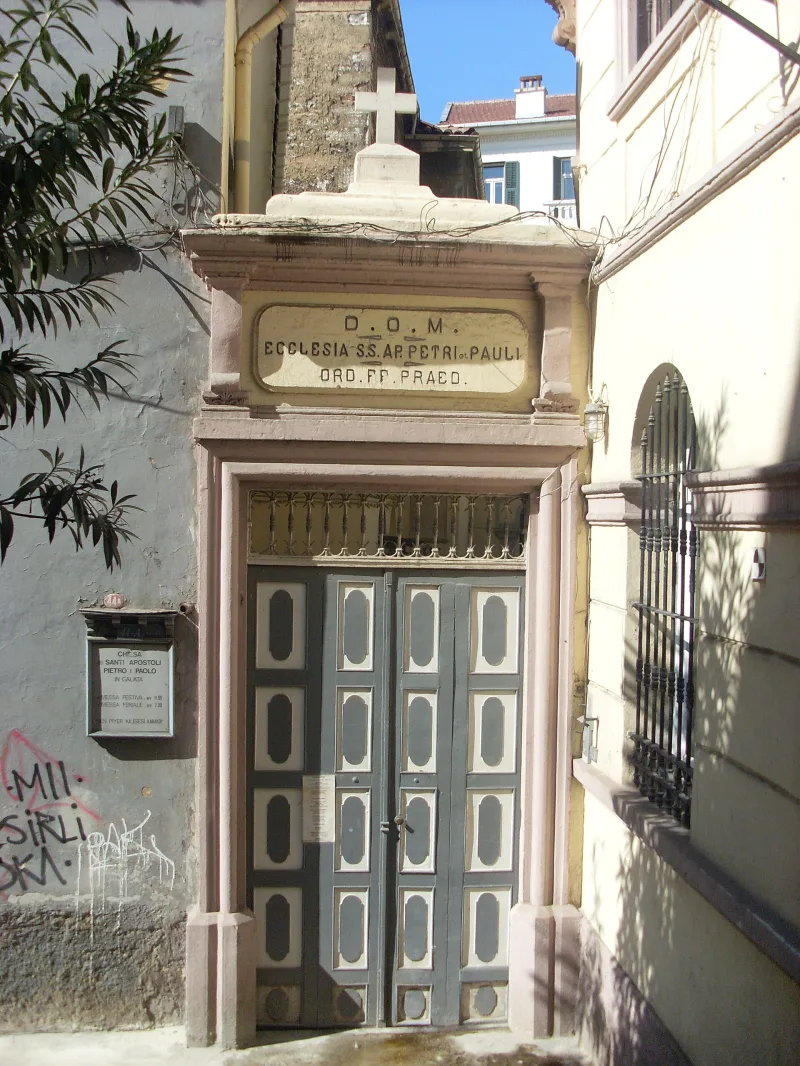
On the narrow street of Galata Kulesi Sokak, just a stone’s throw from the massive stone structure of the Galata Tower, lies a building that is easy to walk past without noticing—a austere facade with almost no decoration, a heavy door, and dovecotes under the roof. This is the Church of Saints Peter and Paul, Istanbul—an active Dominican Catholic church with a history dating back to the 15th century, when Genoese Galata still echoed with Italian speech. The Church of Saints Peter and Paul, Istanbul—a rare occurrence in the city where a single small building connects several eras at once: the Genoese patrons Zaccaria, the firman of the Ottoman sultans, the protectorate of the French kings, the fires of Galata, and the meticulous restoration by the Swiss-Italian Fossati brothers. Inside, beneath a sky-blue dome studded with golden stars, Mass is still celebrated in Italian for the local Maltese community.
History and Origins of the Church of Sts. Peter and Paul, Istanbul
The roots of this community date back to the turbulent year of 1475. Sultan Mehmed II the Conqueror converted the Dominican Church of San Paolo in Galata into a mosque, and the monks were forced to seek a new home. In 1476, they moved two hundred meters east, below the Galata Tower, into a house with a chapel on land belonging to the noble Genoese Zaccaria family. The chapel originally belonged to the Bisticcia family, but by the time the Dominicans moved in, the Zaccarias were already the owners—the property was likely inherited rather than purchased.
In 1535, the Dominicans formally signed an agreement with Angelo Zaccaria, the grandson of the very same Antonio under whom the community had settled on this land. The agreement itself was merely an extension of older arrangements: its opening lines explicitly state that the church had been ceded to the Order long before that date. The terms were renewed every twelve years: the Genoese remained patrons, oversaw the monks’ finances, and could remove clergy who had committed offenses, while the monks undertook to pay for repairs and, on the Feast of the Presentation (Candelora), to present the family with a consecrated candle and celebrate a memorial Mass for the deceased Zaccarias.
In 1603–1604, the chapel was rebuilt into a full-fledged church with a monastery. In 1608, a firman from Sultan Ahmed III placed the complex under the protection of the King of France, and the Venetian Republic allocated an annual subsidy. In 1640, a large icon of the Virgin Mary of the Hodegetria type was moved here; it originally came from the Dominican church in Caffa (Crimea) and was subsequently kept in the Church of Santa Maria di Costantinopoli, which also became a mosque that year. In 1660, the church and monastery burned to the ground—only the icon survived—and under Ottoman law, the land reverted to the treasury. But through the efforts of European powers, a new church was built on the same site in 1702. After the Dominicans refused to hand over the Odigitria to Venice in 1706, the Republic ceased its subsidies. Another fire—the Great Galata Fire of 1731—destroyed the building, and it was rebuilt in wood. Finally, between 1841 and 1843, the Swiss-Italian architects Gaspare and Giuseppe Fossati erected the current stone building.
Architecture and What to See
Externally, the church is restrained to the point of austerity: it blends into the dense fabric of the Genoese quarter, and from the street, only the tall façade, crowned by a small bell opening, is visible. The most interesting features are revealed when you pass through the narrow courtyard-corridor and cross the threshold of the church.
A basilica with a four-sided altar
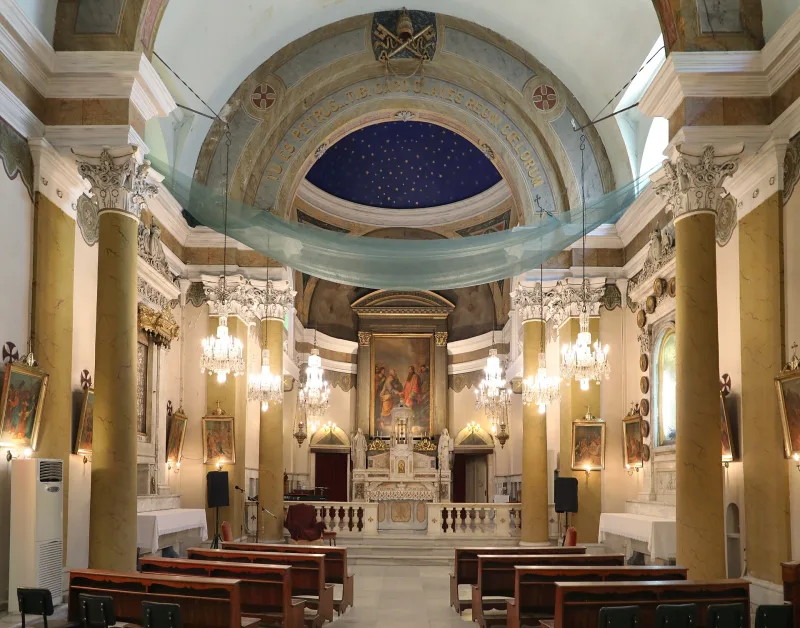
The church’s layout is that of a classical basilica with an altar area arranged so that the altar faces the congregation from several sides. A sky-blue dome studded with golden stars rises above the choir—one of the most recognizable features of the interior. This design element is rare for Catholic churches in Istanbul and immediately distinguishes Saint-Pierre from the neighboring Saint-Antoine and Santa Maria Draperis. Fossati’s architecture here is notably modest: the brothers had just returned from Russia, where they had worked at the court of Nicholas I, and the church project served as their “warm-up” before their major Istanbul commission—the large-scale restoration of Hagia Sophia from 1847 to 1849.
A wall from the Genoese fortifications
One of the church’s most unusual features is its rear wall. It is built directly into a surviving section of the old 14th-century Genoese city fortifications—the very ones that defended the Genoese colony in Constantinople until 1453. It turns out that those praying inside the church have their backs against medieval fortress stones—a rare example where a religious building continues to exist thanks to the military architecture of a previous era.
The Hodegetria Icon from Caffa
The church’s main treasure is an icon of the Hodegetria type, brought here in 1640. It had previously been housed in the Dominican Church of Caffa in Crimea (now Feodosia)—for centuries, Crimea and Galata were “one street” connected by Genoese trade routes—before ending up in Constantinople, where it miraculously survived two fires: in 1660 and 1731. In the early 18th century, it was partially reworked: the Virgin Mary’s mantle was covered with embroidered “lilies of France”—Fleur-de-lis, a reminder of the royal patronage. It is believed that only the face and chest remain from the original image.
Relics and a narrow courtyard with tombstones
The church houses the relics of Saint Renatus, discovered in the catacombs of Galata, as well as fragments of the relics of Saint Thomas, Saint Dominic, and the Apostles Peter and Paul, after whom the church is named. To the east of the entrance stretches a narrow courtyard-passage, as if cut by a knife: its high walls are entirely covered with bas-reliefs and tombstones bearing inscriptions—mostly in Italian. Several more burials are located in the crypt beneath the church. To a Russian-speaking traveler, this courtyard feels almost like a 19th-century Italian cemetery that has miraculously survived in the center of Istanbul.
Saint-Pierre Han Next Door
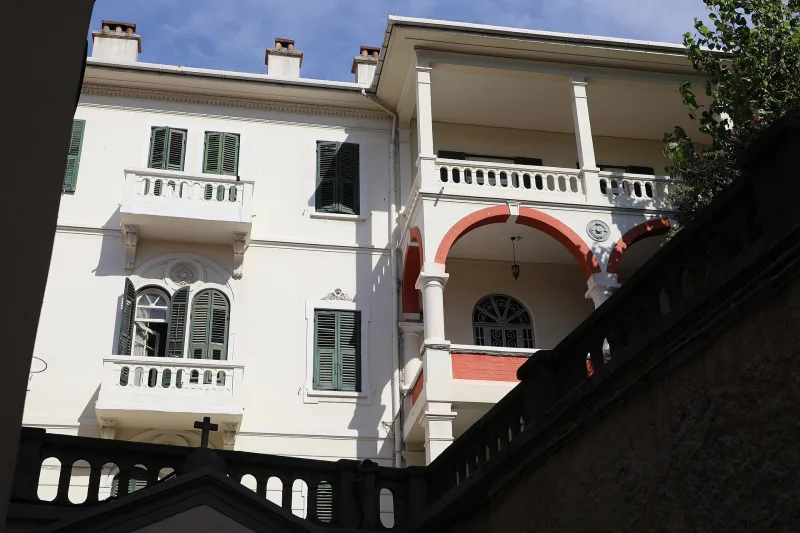
Next to the church stands Saint-Pierre Han—a caravanserai that once belonged to the church as a commercial “support.” Originally a wooden han built in 1732, it burned down in 1770 and was rebuilt in 1771–1772 using durable stone at the initiative of the French ambassador François-Emmanuel Guignard de Saint-Pri. At various times, the building housed the Istanbul Bar Association, the Italian Chamber of Commerce, the Ottoman Bank (on the top floor from 1856 to 1893), a mustard manufacturer, and even a jeans workshop under the brand name Muhteşem Kot—“Magnificent Jeans.” At the turn of the 19th and 20th centuries, the han became a favorite spot for architectural firms: Alexandre Vallori, Ovsep Aznavour, Giulio Mongeri, and designer Alexandre Neokosmos all worked here. Vallori hung a commemorative plaque on the building in honor of the French poet André Chénier, who was born here in 1762. Since 2011, the khan has been leased by the Bahçeşehir Uğur Educational Foundation, which plans to transform it into a cultural center in collaboration with the Istanbul Municipality.
Interesting Facts and Legends
- The Icon of the Mother of God of Caffa is considered one of the protective icons of Constantinople: it is attributed to the hand of the Evangelist Luke himself. It was this icon that the Dominicans saved first in every fire.
- Since the 18th century, the church has been one of the three Catholic parishes of Galata under the French crown—alongside the Jesuit Saint-Benoît and the Capuchin Saint-Georges.
- The parish’s registry books—recording marriages, baptisms, and funerals from the 18th and 19th centuries—are considered an invaluable source for the history of European emigration to Istanbul: Italians, Maltese, Levantines, and refugees from various corners of the Mediterranean arrived in the city via Galata.
- The Fossati brothers, who built the current church in 1841–1843, just a few years later undertook the restoration of Hagia Sophia at the personal behest of Sultan Abdülmecid—a rare instance in which the same architects worked both on the empire’s main mosque and on the small Catholic parish of Galata.
- A commemorative plaque, commissioned by Alexandre Vallory, still hangs on the wall of Saint-Pierre Khan: it commemorates the fact that, according to the beliefs of the time, the poet André Chénier—one of the heroes of the French Revolution—was born here in 1762.
How to get there
The church is located at Galata Kulesi Sokak 44, Kuledibi—literally “under the Galata Tower.” Use the tower itself as a landmark: walking down from it toward the Bosphorus along the narrow cobblestone streets, you’ll reach the church in 3–5 minutes on foot. The most convenient public transportation is the M2 metro line (Şişhane station) and the famous historic Tünel funicular: from its lower station in Karaköy, it’s about a 7–10-minute walk uphill to the church.
An alternative route is the T1 tram (Bağcılar–Kabataş) to the Karaköy stop, then walking up Galata Kulesi Caddesi or taking the Tünel funicular to the Karaköy station and continuing along a short alley. From Istanbul Airport (IST), the most convenient way is to take the M11 metro to Kağıthane, then transfer to the M7 to Şişhane. From Sabiha Gökçen Airport (SAW)—take the Havabus to Taksim and then walk along Istiklal or take the Tünel. Admission to the church is free, but you can only enter during the hours when the gates are open—usually in the morning and during Mass; at other times, the gatekeeper will open the gates upon request.
Tips for travelers
The best time to visit is spring (April–May) and fall (September–October): there is no shade in the narrow streets of Galata, and it gets stuffy here in the summer, while in the winter, rain makes the marble slabs and stairs slippery. Allow 30–60 minutes for your visit: the church is small, but you’ll want to stand before the icon of the Hodegetria, read the inscriptions on the tombstones in the courtyard, and look up at the blue dome studded with stars. If you happen to catch a Mass in Italian (usually on Sunday mornings), it’s best to put off taking photos and just sit in the back rows—this is an active parish of the Maltese community, not a museum.
Photographers should note that the exterior facade is difficult to photograph due to the narrow street: the best shots come from inside the courtyard and from the side aisle with the tombstones, where the side light plays on the carved slabs. Flash photography is prohibited inside, but the daylight streaming in from the upper windows is more than enough for shooting with a modern smartphone. Bring some small change in euros or liras—for a candle and the donation box; this is an unspoken way of showing gratitude for the open access. Dress as you would in any active place of worship: shoulders and knees covered, and speak quietly.
Logistically, the church fits perfectly into a half-day walk through Galata: Galata Tower (a 2-minute walk) with a view of the Golden Horn, the 1875 Tünel funicular—the second oldest in the world, Istiklal Street with its nostalgic little tram, the Church of St. Anthony of Padua on Istiklal, and the workshops on Galip Dede Caddesi. Those who enjoy Russian-Istanbul parallels will find echoes of Odessa and Feodosia here: Genoese trade, Crimean icons, the Levantine community—all part of the same Mediterranean world that, in the 19th century, linked Istanbul, Crimea, and the Black Sea region into a single cultural arc. That is precisely why the Church of Saints Peter and Paul in Istanbul is worth visiting not as “just another church,” but as a small hub of memory where Genoa, France, Venice, Crimea, and the Ottoman Empire—and where today, beneath a blue dome studded with golden stars, the parish still thrives.